Earlier this fall, several members of the Back to Nature crew traveled to Louisville, Kentucky to attend Hardscape North America, the largest hardscape and landscape trade show in North America. The event brought together contractors, manufacturers, and educators from across the country to showcase the latest tools, materials, and techniques shaping the future of outdoor living.
For our team, the value was in seeing the industry up close and learning what’s next. “It’s one thing to hear about new products or techniques, but seeing them in person and watching how they’re actually used makes a big difference,” said Mickey Quesenberry, Director of Operations.
Walking the show floor, the crew explored new paver styles, retaining wall systems, equipment, and tools designed to improve both efficiency and finished results. “There were a lot of smart tools and materials focused on doing the job better and cleaner,” Mickey shared. “It gives you ideas you can bring back and apply right away.”
Hands-on demonstrations and education sessions were another highlight. These covered best practices for base preparation, drainage, installation techniques, and overall jobsite efficiency. “The demos were huge for me,” Mickey said. “You always pick up small tips that end up saving time and improving quality on real projects.”
Beyond products and techniques, the event also highlighted broader trends in outdoor living, including durability, sustainability, and designs that balance function with long-term performance. “You can really see where the industry is heading,” Mickey noted. “It helps us make better recommendations and build spaces that last.”
Experiences like Hardscape North America reinforce Back to Nature’s commitment to investing in our people and our craft. By continuing to learn, stay connected, and bring fresh ideas home, we’re better equipped to deliver thoughtful, high-quality outdoor spaces for our clients throughout the New River Valley.
Winter may seem like a quiet season in the landscape, but it’s actually a great time to tidy up and prepare your yard for a beautiful year ahead.
With plants dormant and summer’s lush growth behind us, winter cleanup offers several surprising advantages:
Clear visibility: When trees and shrubs have shed their leaves, it’s much easier to see a property’s structure—overgrown branches, damaged limbs, and clutter become more obvious. This makes pruning and clearing more efficient and effective.
Protect plant health: Removing diseased or dead branches now helps prevent problems from spreading when spring growth returns. Cleaning up leaves, debris, and fallen fruit also reduces overwintering pests and fungal issues.
Prevent damage: Cold weather storms can weigh down weak limbs and cause breakage. Addressing potential hazards early protects your home, garden structures, and loved ones.
Make space for Spring: Winter is the perfect time to get ahead on edging, clearing out beds, and removing unwanted plants before spring planting and mulching season arrives. You’ll be ready to jump straight into the fun part—new designs and fresh color!
Enjoy a cleaner, more welcoming landscape year-round: Even in winter, outdoor spaces should feel inviting. Tidying pathways, trimming shrubs, and organizing utility areas can instantly improve how your home looks and how you enjoy it through the colder months.
If you’re ready to freshen up your landscape this winter, our team is here to help. With a little attention now, your yard will look tidy today—and burst into spring with its best foot forward!
“Site prep is where the magic happens!” – Back to Nature installer
A well-designed landscape considers how people will truly use the space: their activities, needs, comfort, and style preferences. When done right, this planning process takes time and thoughtful reflection.
Winter is the perfect season to look ahead and think about how your outdoor spaces could become more enjoyable for you and the people you care about. If you’re thinking about updates or changes, pour a warm cup of coffee or tea, gather others who enjoy your yard, and explore the questions below. Write down your thoughts—you might be surprised by what you discover!
Questions to consider:
What do I enjoy doing most in my yard?
Are there activities I’ve enjoyed in other outdoor spaces that I’d love to be able to do at home?
When I host friends or family, is there enough space—or do I sometimes wish for more?
Do my guests seem comfortable outdoors? Could the space be more inviting—such as protection from wind, more comfortable seating, or screening from neighbors or harsh sun?
Is it easy to move around the yard? Are there steep slopes or areas I avoid because they’re hard to navigate or not useful?
Do I have practical, well-organized spaces for trash bins, compost, and equipment storage?
If I have a vegetable garden, could it be more enjoyable or easier to work in? Would better fencing or raised beds help?
What styles of landscapes inspire me—Clean, tailored, symmetrical plantings? Natural plantings with lots of variety and a loose, romantic feel?Charming cottage gardens? How might I bring more of that style into my yard with plants or built features like arbors, trellises, or edging?
Does my landscape feel alive? Are birds, pollinators, and butterflies present—and would I like to support more wildlife to make the space feel vibrant?
Which parts of the yard are difficult to maintain? Are there plantings I should replace or alter to make care more manageable?
What outdoor maintenance tasks do I actually enjoy?
How much time do I want to spend on maintenance? (Don’t laugh—many people love pulling weeds or deadheading flowers to unwind after a busy day!)
Consider the budget you could spend on your improvements. Remember that many improvements can be implemented in phases over several years.
Once you’ve spent time thinking about these questions, gather some inspirational images, and invite us to help you make your new plans a reality! Your dream landscape starts with great planning—and we’d love to be part of that journey!
If we could choose where snow fell, we could enjoy all the fun snow has to offer—making snowmen, sledding, and more—without the hassle of clearing paths to get to work or run errands. Unfortunately, after enjoying the snow, we’re still left with the chore of clearing driveways and walkways.
Walkways and driveways
Check Your Health Beforehand: Snow removal is hard work, and if you have heart problems or other health concerns, check with your doctor early in the season. If needed, arrange for someone else to handle snow removal when necessary.
Shoveling Techniques: Use proper form: bend at the knees rather than the back, and avoid lifting too much snow at once. Take frequent breaks and pay attention to how your back and body feel. If you experience discomfort, stop and rest.
Start Early: Fresh snow is lighter and easier to shovel than snow that has settled or formed a crust of ice. Clear paths promptly after a snowfall.
Use De-Icers Wisely: Apply ice melt or sand to reduce slipperiness. Note that overuse can damage nearby plants. Use chemicals that are safe for the surface you are applying them to – some can damage concrete or concrete pavers.
Stay Safe
Keep your phone with you in case of injury, and listen to your body. If something feels “off,” it’s safer to stop and finish later.
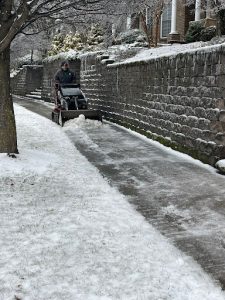
Man operating a compact snow removal machine to clear an icy sidewalk beside a stone retaining wall during winter.
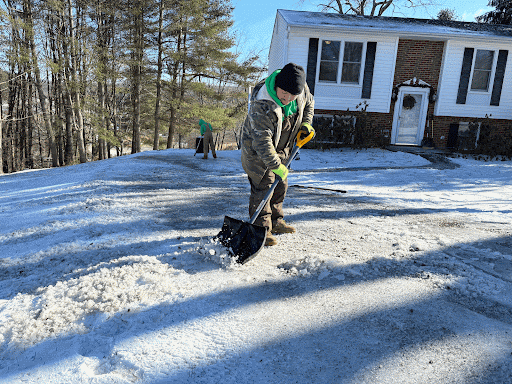
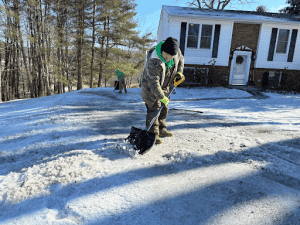
Workers shoveling snow and ice from a residential driveway on a sunny winter day, ensuring safe access to the home.
Evergreens
While most plants are fine in the snow, a heavy layer can damage evergreens. Here’s how to care for these plants after a storm:
Gently Remove Snow: Use a broom or your gloved hands to brush snow off branches. Sweep upward rather than downward to avoid adding stress to branches already weighed down.
Avoid Shaking Branches: Sudden movements can cause branches to snap under the pressure.
Leave Ice Alone: If branches are coated with ice, let it melt naturally. Attempting to remove ice can cause more harm than good.
By addressing snow removal thoughtfully, you can maintain safe paths, preserve the health of your evergreens, and protect your property from winter’s challenges.
Clean, curved asphalt pathway cleared of snow, surrounded by snowbanks on both sides, showcasing effective winter snow removal.
During the winter, deer browse on buds and twigs of woody plants, especially when snow covers other herbaceous growth. While that’s fine in the forest, deer browsing can leave the plantings around our homes looking sparse and misshapen. Deer repellents, plant selection, placement and physical barriers are all tools that can help lessen or prevent deer browsing.
Deer Repellents
There are a variety of deer repellents on the market. Experiment to find the ones that work best for you. Note that some are based on smells that are intended to repel deer, while others depend on unpleasant tastes, like pepper. Reapply according to the label. Using a repellent makes it less likely for deer to browse your plants, but can’t guarantee complete protection.
Plant Selection
Plant selection is an important part of gardening in deer country. Very few plants are completely unpalatable to deer, though boxwoods, daffodils, and ornamental grasses come close. To find the best options for your yard, look around your neighborhood to see what the deer are leaving alone, talk to folks at your local nursery, contact local Master Gardener chapters, or look online. We like the Missouri Botanical Garden Plant Finder or the list from Rutger’s Extension Service.
Some plants that we have had good success with include:
Ornamental grasses
Sedges
Boxwoods
Colorado blue spruce
Cryptomeria sp.
spirea
Ferns (though if there are high populations, they will nip the tender tips off in spring)
Lavender
Russian sage
Catmint (Nepeta sp.)
Daffodils
Lamb’s ear
Lenten rose
Mountain mint (Pycnanthemum sp.)
Amsonia sp.
Colorado blue spruce
Plant Placement
You may notice that deer travel in certain patterns through your yard. In those areas, use plants that are the most resistant to deer damage (ex. boxwood, ornamental grasses, etc.). Deer may shy away from areas of higher activity, like a front door or near a busy street, allowing you to use a wider variety of plants. For those of you that spend months in another location, deer can get very bold when a home is unoccupied, and so the most resistant plants would be best suited for that landscape.
Barriers
For young plants or particularly special plants in your landscape, you can put up temporary barriers to deer browsing using netting or wire cages. Wire cages around trees and shrubs should be about 6′ tall. Smaller shrubs can have shorter cages, but should be closed off at the top. These can be removed in spring when food sources are more plentiful. You can also use these barriers on trees and shrubs that will grow taller to give them protection until they outgrow the reach of most deer.
Feeding More Than the Birds
Many people love feeding the birds, but be aware that bird feeders can attract deer, as well. If you see deer tracks around your bird feeder, consider hanging them higher where deer can’t reach them.
If the deer population is high enough, and they are hungry enough, your landscape may still experience some deer damage. But with the right mix of plant choices and protection, you are much more likely to enjoy a beautiful, thriving landscape—without turning it into a deer buffet!
Let us help!
We can help you install wire cages, deer fencing, and schedule you for regular applications of deer repellent if you would like help protecting your landscaping plantings
We use cookies to ensure that we give you the best experience on our website. If you continue to use this site we will assume that you are happy with it.